
Hamid Khoshayand – Regional Affairs Expert
The recent statements by Mike Huckabee, the US Ambassador to occupied Palestine, have sounded alarm bells throughout the West Asia region. Huckabee, who had previously spoken of the Zionist regime’s biblical right to dominate the region from the Nile to the Euphrates, this time declared with greater explicitness: “It would be very nice if they [the Zionist regime] could dominate everything.” These remarks represent the most explicit admission by a US official of a project that had remained shrouded in ambiguity until recently.
Huckabee’s statements in Tel Aviv, accompanied by Washington’s implicit support, indicate that US support for the “Greater Israel” project has gained operational traction with the appointment of ambassadors who openly seek domination over everything. Huckabee is not just a diplomat or an ordinary ambassador, but a figure close to neoconservative circles that are influential in Washington’s decision-making.
The remarks of the US Ambassador in the occupied territories have faced widespread opposition and condemnation from Arab and Islamic countries. Fourteen Arab and Islamic countries, including Jordan, the UAE, Saudi Arabia, Egypt, Turkey, Qatar, Kuwait, Bahrain, Oman, Lebanon, Syria, Indonesia, Pakistan, and Palestine, along with the secretariats of the Organization of Islamic Cooperation, the Arab League, and the Persian Gulf Cooperation Council, issued a joint statement in Amman expressing the depth of their concern over the unprecedented expansionism of the Zionist regime and describing Huckabee’s statements as a flagrant violation of international law and a serious threat to regional security and stability. They emphasized that the Zionist regime has no sovereignty whatsoever over the occupied Palestinian territories or other occupied Arab lands and strongly rejected any attempt to alter borders.
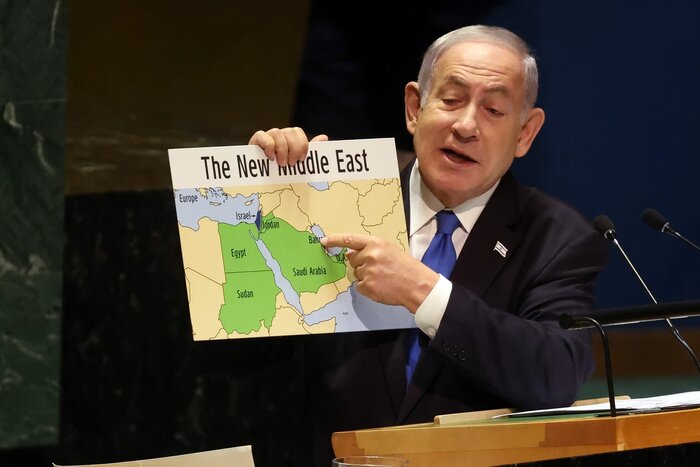
Recently, Seyed Abbas Araghchi, the Minister of Foreign Affairs of the Islamic Republic of Iran, rightly warned at the Al Jazeera Forum meeting in Qatar: If the Gaza issue is resolved through destruction and forced displacement, the West Bank will be next. Annexation will become official policy. This is the essence of what has long been called the “Greater Israel” project. This warning becomes more serious when we realize that the map envisioned by the Zionists includes not only the West Bank but also vast territories from neighboring countries.
The reality is that the expansionism of the Zionist regime knows no logic or borders. If the pattern of border changes and forced displacement becomes entrenched in Gaza, the West Bank will undoubtedly be the next target, followed by countries whose names are inscribed on the map from the Nile to the Euphrates, including Jordan, Lebanon, Syria, Iraq, and Saudi Arabia. Jordan, sharing the longest border with the West Bank and hosting a significant Palestinian population, stands on the front line of this threat. Lebanon, with its water resources and strategic location, and Iraq, with its historical and civilizational depth, are subsequent targets of this expansionism.
But more dangerous than the expansionism seriously pursued by the Zionist regime is the use of religious interpretations to provide it with political and legal cover. The US Ambassador in occupied Palestine, by explicitly referencing Jewish texts and concepts such as biblical rights, attempts to bestow divine legitimacy upon this project.
Such a perspective makes the issue far more dangerous, because it interprets any opposition not within the framework of a political or legal conflict, but as a confrontation with a transcendental and sacred will. This approach eliminates any possibility of compromise or peaceful solution and turns war into an inevitable fate.
As mentioned, the statements of the US Ambassador in Tel Aviv should serve as a serious wake-up call and, indeed, a lesson for all governments in the region and the Islamic world. Silence, appeasement, and even the alignment of some Arab and Islamic governments with the actions of the Zionist regime have not only failed to curb this regime but have led to counterproductive results.
Today, even those countries that thought they could secure their security through the normalization of relations and the signing of security pacts find their territorial integrity under serious threat. Experience has shown that the Zionist regime has an insatiable appetite for expansionism and will not stop until it is met with resistance.
What is being discussed in some Zionist circles goes beyond current recognized borders, and this reality demands attention and reflection from all Islamic and Arab nations and governments. Ignoring this regime’s expansionism may pave the way for more serious challenges in the future. Experience has shown that the equation of peace for land no longer suffices for the current situation; what matters today is preserving the survival, security, and independence of nations against any threat. The continuation of the Zionist regime’s expansionist policies raises a question for everyone: Will the future of the region be shaped based on collective resistance or acceptance of imposed changes?
In simpler terms, in the face of the territorial expansionism of the Zionist regime, there are only two paths: either stand against it with strength, or prepare to accept a tomorrow in which the names of important countries that today possess sovereignty and independence are inscribed on the map of “Greater Israel.”
This text was translated using artificial intelligence and may contain errors. If you notice a clear error that makes the text incomprehensible, please inform the website editors.








0 Comments