
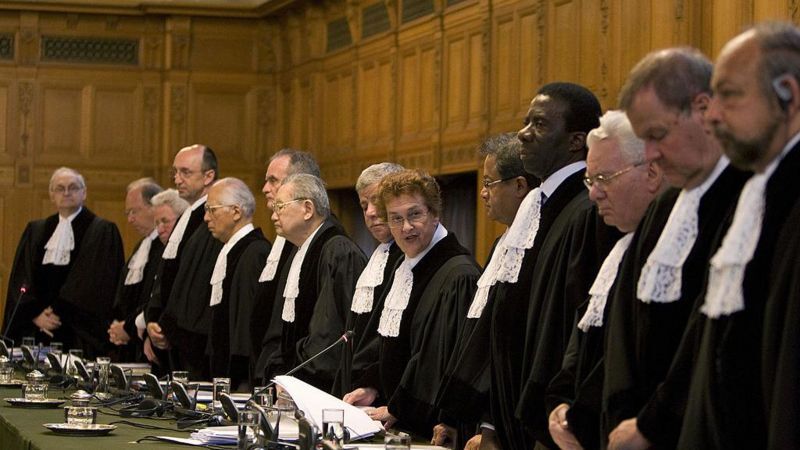
In an interview with the website of the Strategic Council on Foreign Relations, Dr. Mohsen Jalalivand, referring to the recent opinion of the International Court of Justice (ICJ), said: “This opinion is not merely an advisory view, but a clear declaration of the international responsibility of the Zionist regime for violating humanitarian law.” He added: “The Court, with unprecedented clarity, emphasized that the Israeli regime is still considered the occupying power in Gaza and that no security argument can justify the humanitarian blockade and the obstruction of relief efforts.”
According to the international affairs expert, “Such an opinion practically establishes a new framework for legally holding the Israeli regime accountable in international organizations, because for the first time, the Court has emphasized the direct link between the responsibility of the occupying state and the right to life of civilians and has interpreted this matter at the level of binding obligations.”
Jalalivand clarified: “This opinion can form the basis for subsequent actions by the United Nations General Assembly and possibly the Security Council; especially if Islamic and Arab countries, using it, formally place the issue of lifting the blockade of Gaza on the Council’s agenda.” He recalled: “In the text of its opinion, the Court has obligated the Israeli regime to allow the free passage of humanitarian aid and to refrain from any actions against UN personnel and offices.” According to him, this clause amounts to an implicit affirmation of “the legal status of UNRWA and the international immunity of humanitarian activities, and it calls into question Tel Aviv’s efforts to close this agency’s offices in East Jerusalem.”
Global Reaction and the Beginning of a New Chapter in Legal Diplomacy
Jalalivand further emphasized: “The Court’s new opinion has triggered a wave of global reactions. Indeed, the European Union, the African Union, and the UN Secretary-General have welcomed this opinion, considering it a step towards reviving the fundamental principles of human rights. In contrast, Tel Aviv and its close allies have tried to portray this opinion as merely political. Still, the strong legal arguments and repeated references to the Fourth Geneva Convention have closed the path to any political interpretation.”
The international affairs analyst noted: “From now on, any action by the Israeli regime to prevent humanitarian aid could be considered a systematic violation of international law and pave the way for legal prosecution in international bodies.” He added, “This opinion also carries moral and political obligations for third-party states. Countries that still directly or indirectly support the blockade of Gaza may henceforth face increasing pressure from public opinion and even the threat of legal actions.”
Jalalivand believes: “The immediate effect of this opinion is the strengthening of the global legitimacy of the Palestinian issue within the framework of international law; especially at a time when many governments have tried to interpret the Gaza issue solely as a humanitarian crisis and not a legal one.” He recalled: “Now Palestine is once again on the agenda of the international community as a legal and ethical issue, and this calls the political credibility of the Israeli regime into question in global circles.”
Limiting the Israeli Regime’s Room for Maneuver on the Global Stage
In another part of the interview, Jalalivand pointed to the political consequences of the Court’s opinion for the Israeli regime and said: “This opinion has placed the Zionist regime in a position where continuing the status quo is no longer possible. Tel Aviv, on the one hand, faces increasing pressure from international institutions. On the other hand, the traditional support of the United States and some Western countries has also been weakened due to the legal burden and public opinion pressure.”
He added: “The United States will also adopt a dual policy in response to this opinion; meaning Washington will not officially criticize the Court, but in practice, it will hinder the full implementation of its provisions; because any explicit acceptance of this opinion would mean endorsing the Israeli regime’s occupation and violation of humanitarian obligations, the political consequences of which would be heavy for America.”
The university professor noted: “The Court’s new opinion is a continuation of last year’s opinion on the illegality of the occupation of Palestine and establishes a common legal foundation for subsequent actions by international institutions.” Jalalivand said: “In this opinion, the Court carefully emphasized concepts such as the prohibition of starving civilians, forced displacement, and restrictions on humanitarian aid. These are clear instances of war crimes and could pave the way for referring the case of the Israeli regime to the International Criminal Court (ICC).”
The analyst clarified: “Such developments will cause the Israeli regime to be increasingly in a defensive and isolated position on the international stage.” Jalalivand believes: “The world is now witnessing a transition from the discourse of the Israeli regime’s security to the discourse of international accountability; meaning where invoking security issues is no longer a legal shield for actions that violate human rights.”
He concluded by emphasizing: “The International Court of Justice’s opinion, if persistently pursued by independent countries and regional institutions, could become a historic document for ending the blockade of Gaza and reviving the United Nations’ role regarding Palestine. This opinion showed that international law, although slow, can still resist power and politics.”





0 Comments