China-U.S. Competition for Dominance in Global Trade

2025/11/02 | Economy, Note, top news

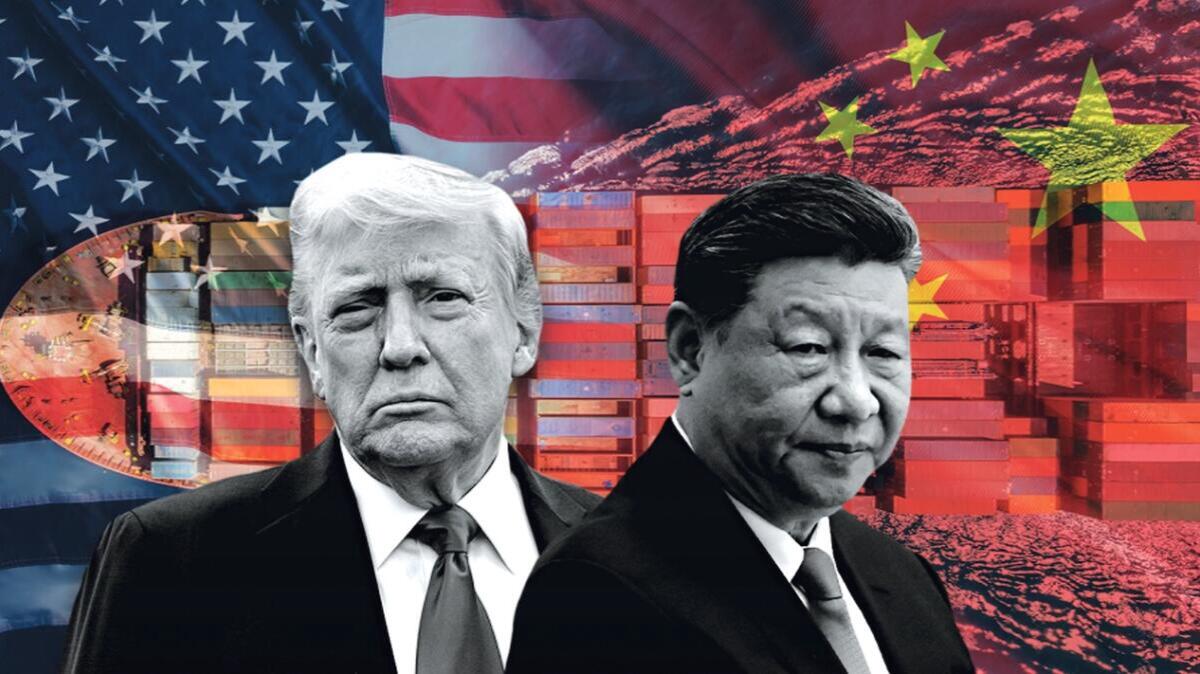
Strategic Council Online– Opinion: While the world has not yet been freed from the consequences of the pandemic and geopolitical disruptions, the economic competition between the world's two giants – the United States and China – in East Asia has reached its peak.

Sina Raymand – International Relations Analyst
Recently, the United States, under the leadership of Donald Trump, signed bilateral trade agreements with four Southeast Asian countries (Malaysia, Cambodia, Thailand, and Vietnam) to move supply chains away from China. In response, China signed the protocol to upgrade the free trade agreement with the Association of Southeast Asian Nations (ASEAN) to version 3.0, focusing on digital trade, the green economy, transportation, and supply chains.
This agreement targets a market of 2 billion people with a GDP of $3.8 trillion and strengthens bilateral trade, which reached $1 trillion last year. These moves have turned Southeast Asia into the main arena for the competition to dominate global trade. In this analysis, we examine the mechanisms of this competition and outline probable scenarios.

Competitive Strategies: Tariffs vs. Integrity
U.S. Strategy: Protectionism and “Friendshoring”
Trump, by reviving the trade war, has imposed heavy tariffs (up to 145% on Chinese goods) to bring production back to the U.S. and its allies. The recent agreements with ASEAN cover 68% of the $475 billion in bilateral trade and focus on critical minerals, agriculture, and investment.
This approach is part of “Friendshoring,” which shifts supply chains to Vietnam, India, and Mexico. According to estimates, the tariffs will generate $2.9 trillion in revenue by 2034 but will reduce U.S. GDP growth by 0.23%. Initiatives like the IPEF (Indo-Pacific Economic Framework) are also designed to counter China’s RCEP (Regional Comprehensive Economic Partnership).
China’s Strategy: Openness and Regional Influence
China, by upgrading CAFTA 3.0 (China-ASEAN Free Trade Agreement version 3.0), is positioning itself as a trade alternative. This agreement removes non-tariff barriers and emphasizes the green and digital economy – areas where bilateral trade in the first nine months of 2025 grew by 9.6% to $785 billion. The Belt and Road Initiative (BRI), with massive investments in ASEAN infrastructure, makes China a leader in global supply chains. Chinese sources like China.org.cn describe this as a “win-win cooperation” rather than “American unilateralism.” China has also created leverage by restricting exports of rare earth elements.
ASEAN’s Role: Smart Balancing of Relations
ASEAN, with a collective GDP of $3.8 trillion, is the key to victory for either side in this competition. Malaysian Prime Minister Anwar Ibrahim emphasized “ASEAN centrality” yesterday with Trump, today with China. However, the Philippines, alluding to the situation and trend of confrontation with China in the South China Sea, warned that cooperation should not involve “coercion.” Vietnam and Thailand benefit from supply chain shifts, but Trump’s tariffs also put pressure on ASEAN. According to a Bloomberg report, the region, conditional on partner diversification, could benefit from the competition.

Global Consequences: Supply Chain Restructuring and Weakening of the WTO
It must be considered that this competition is polarizing global trade. Supply chains are shifting from China to ASEAN, evidenced by a 30% increase in FDI in Vietnam, but costs have increased, with global inflation at 1-2% and economic growth 0.5% lower. Meanwhile, the World Trade Organization (WTO) has been weakened, and regional blocs (RCEP vs. CPTPP) have become the dominant powers. China has already taken the leading position, with its share of global trade reaching 14%, compared to 11% for the U.S.

Future Scenarios: From Escalating Trade War to Limited Compromise
Scenario 1: Escalating Trade War (40% probability): If the Trump-Xi meeting at the APEC summit in South Korea (Thursday) fails, tariffs could reach 200%. China responds with counter-sanctions and the BRI. ASEAN would be the main loser in this process, experiencing 1% lower growth and 3% inflation. Supply chains would become completely polarized, with “China+1” versus “America+Friend.”
Scenario 2: Limited Compromise (35% probability): The Wall Street Journal reports that the U.S. might reduce tariffs in exchange for controls on fentanyl and soybean purchases. Bloomberg predicts this detente would limit the impact of tariffs, with U.S. economic growth at +0.5% and China’s at +1%. In this case, ASEAN wins, and trade growth would be +10%.
Scenario 3: Victory of the Smart Balancing Strategy with ASEAN (20% probability): ASEAN, leveraging its centrality, balances both sides. RCEP and the new CAFTA version guarantee 7% regional economic growth. Trump competes for minerals, Xi for markets.
Scenario 4: Complete Decoupling (5% probability): In this case, two parallel economies form. This would result in a 5% loss in global GDP by 2030.

Conclusion: An Emerging Multipolar World
The China-U.S. competition has turned trade from a liberal domain into a strategic issue. China is ahead in openness and influence, but Trump could reverse this trend by leveraging tariffs. ASEAN is the key to this competition, and smart balancing of relations creates the optimal scenario. Global leaders should prioritize green and digital cooperation instead of a zero-sum game. The APEC meeting will be a turning point, and global markets are awaiting this development.
0 Comments

LATEST CONTENT

America’s Zero-Sum Game in Iraq

Online Strategic Council – Memoir: The swift selection of Nouri al-Maliki for the premiership constitutes a new phase in Iraq’s political sphere. Multiple factors have played a role in this process, the most important being the prevailing situation in Iraq and the region. Under such circumstances, Iraq requires a powerful and experienced prime minister who can keep the country away from the dangers of wars and crises.

America’s Strategy for Creating Tension in the Asia-Pacific

Strategic Council Online – Opinion: Relations between some countries in the Asia-Pacific region, such as China and Japan or China and Australia, which were previously relatively normal, are trending towards deterioration, and the primary reason for this is the aggressive policies of the United States of America.

The Collapse of the European Security Illusion with the Continuation of the Ukraine War?

Strategic Council Online – Interview: The Ukraine war has become a new turning point in the political, security, and even commercial relations of allies on both sides of the Atlantic. While this war is nearing its fourth year, many questions still remain regarding its future and its consequences; among them, will the continuation of the Ukraine war lead to the collapse of the European security illusion?

Is Greenland Pushing Europe Toward China?

Strategic Council Online – Interview: A European affairs expert believes that the seizure of Greenland will certainly weaken America’s relations with Europe and its allies. Donald Trump’s view is that he does not need these countries, but if Europe faces significant pressure from the United States, it is natural for it to move toward China.

Alarm Bells Sound for ISIS Revival in Syria: Threat to Iraq and West Asia

Strategic Council Online – Opinion: Numerous documents and pieces of evidence indicate that ISIS, which in recent years has been the region’s biggest threat to security and stability after the Zionist regime, has once again in recent months become a focal point for political and security exploitation by American and Zionist regime security, intelligence, and political circles.

Afghanistan’s Effective Role in the Economy of Eurasia

Strategic Council Online – Interview: A regional affairs researcher stated: Despite projects such as the Khaf-Herat railway and the Herat-Balkh-Mazar-i-Sharif corridor being on the agenda, insecurity and the absence of an inclusive government remain the most significant obstacles to realizing transit corridors and Afghanistan playing an effective role in the economy of Eurasia.

Loading

Últimas publicaciones

America’s Zero-Sum Game in Iraq

Online Strategic Council – Memoir: The swift selection of Nouri al-Maliki for the premiership constitutes a new phase in Iraq’s political sphere. Multiple factors have played a role in this process, the most important being the prevailing situation in Iraq and the region. Under such circumstances, Iraq requires a powerful and experienced prime minister who can keep the country away from the dangers of wars and crises.

America’s Strategy for Creating Tension in the Asia-Pacific

Strategic Council Online – Opinion: Relations between some countries in the Asia-Pacific region, such as China and Japan or China and Australia, which were previously relatively normal, are trending towards deterioration, and the primary reason for this is the aggressive policies of the United States of America.

The Collapse of the European Security Illusion with the Continuation of the Ukraine War?

Strategic Council Online – Interview: The Ukraine war has become a new turning point in the political, security, and even commercial relations of allies on both sides of the Atlantic. While this war is nearing its fourth year, many questions still remain regarding its future and its consequences; among them, will the continuation of the Ukraine war lead to the collapse of the European security illusion?

Is Greenland Pushing Europe Toward China?

Strategic Council Online – Interview: A European affairs expert believes that the seizure of Greenland will certainly weaken America’s relations with Europe and its allies. Donald Trump’s view is that he does not need these countries, but if Europe faces significant pressure from the United States, it is natural for it to move toward China.

Alarm Bells Sound for ISIS Revival in Syria: Threat to Iraq and West Asia

Strategic Council Online – Opinion: Numerous documents and pieces of evidence indicate that ISIS, which in recent years has been the region’s biggest threat to security and stability after the Zionist regime, has once again in recent months become a focal point for political and security exploitation by American and Zionist regime security, intelligence, and political circles.

Afghanistan’s Effective Role in the Economy of Eurasia

Strategic Council Online – Interview: A regional affairs researcher stated: Despite projects such as the Khaf-Herat railway and the Herat-Balkh-Mazar-i-Sharif corridor being on the agenda, insecurity and the absence of an inclusive government remain the most significant obstacles to realizing transit corridors and Afghanistan playing an effective role in the economy of Eurasia.

Loading

DERNIER CONTENU

America’s Zero-Sum Game in Iraq

Online Strategic Council – Memoir: The swift selection of Nouri al-Maliki for the premiership constitutes a new phase in Iraq’s political sphere. Multiple factors have played a role in this process, the most important being the prevailing situation in Iraq and the region. Under such circumstances, Iraq requires a powerful and experienced prime minister who can keep the country away from the dangers of wars and crises.

America’s Strategy for Creating Tension in the Asia-Pacific

Strategic Council Online – Opinion: Relations between some countries in the Asia-Pacific region, such as China and Japan or China and Australia, which were previously relatively normal, are trending towards deterioration, and the primary reason for this is the aggressive policies of the United States of America.

The Collapse of the European Security Illusion with the Continuation of the Ukraine War?

Strategic Council Online – Interview: The Ukraine war has become a new turning point in the political, security, and even commercial relations of allies on both sides of the Atlantic. While this war is nearing its fourth year, many questions still remain regarding its future and its consequences; among them, will the continuation of the Ukraine war lead to the collapse of the European security illusion?

Is Greenland Pushing Europe Toward China?

Strategic Council Online – Interview: A European affairs expert believes that the seizure of Greenland will certainly weaken America’s relations with Europe and its allies. Donald Trump’s view is that he does not need these countries, but if Europe faces significant pressure from the United States, it is natural for it to move toward China.

Alarm Bells Sound for ISIS Revival in Syria: Threat to Iraq and West Asia

Strategic Council Online – Opinion: Numerous documents and pieces of evidence indicate that ISIS, which in recent years has been the region’s biggest threat to security and stability after the Zionist regime, has once again in recent months become a focal point for political and security exploitation by American and Zionist regime security, intelligence, and political circles.

Afghanistan’s Effective Role in the Economy of Eurasia

Strategic Council Online – Interview: A regional affairs researcher stated: Despite projects such as the Khaf-Herat railway and the Herat-Balkh-Mazar-i-Sharif corridor being on the agenda, insecurity and the absence of an inclusive government remain the most significant obstacles to realizing transit corridors and Afghanistan playing an effective role in the economy of Eurasia.

Loading